 Skip to content


Hail damage on a shingle roof shows up as dark, round spots where the granules have been knocked off, often with a soft, bruised feel underneath. Hail one inch across or bigger is the size the National Weather Service calls severe, and Texas gets more of it than any other state. This post shows what real hail hits look like on Texas roofs, what you can check from the ground, and what a roofer looks for up top.
Quick answer
- A hail hit on asphalt shingles is a random, roughly round spot of missing granules, sometimes with a soft bruise or a crack in the mat underneath.
- The National Weather Service treats hail of 1 inch (quarter size) and larger as severe. Smaller hail can still strip granules and weaken an older roof.
- Start on the ground: dented gutters and vents, granules at the downspouts, and dinged screens or AC fins after a storm all point to hail.
- Don’t climb a wet or steep roof. A roofer marks hits in test squares on each slope and photographs them for the adjuster.
- Texas recorded 902 hail events with stones an inch or larger in 2025, more than any other state.
What does hail damage look like on a roof?
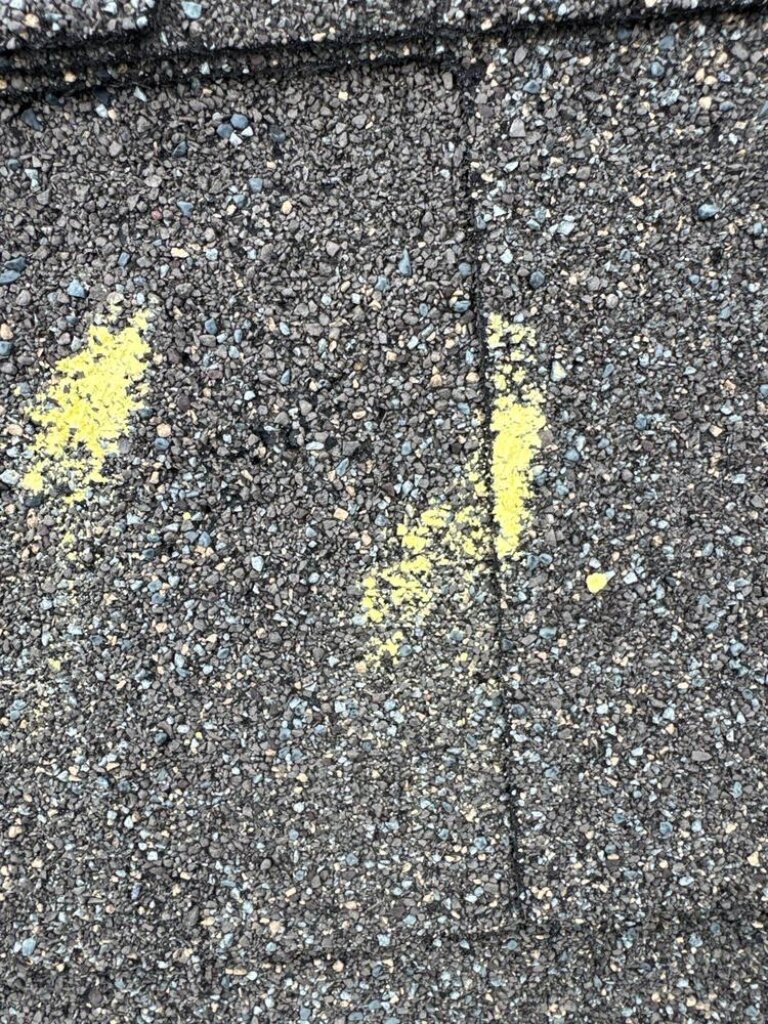
On asphalt shingles, a fresh hail hit looks like a dark circle where the colored granules are gone and the black asphalt shows through. Press it and it can feel soft, like a bruise on an apple. Bigger stones can crack the shingle mat or punch through it.
The key word is random. Hail falls everywhere at once, so the hits are scattered across a whole slope with no pattern. Damage that lines up along a walkway, sits only at the edges, or follows the shingle seams usually has another cause.

Hail damage or something else?
Plenty of roof wear looks like hail at first glance. Insurance adjusters know the difference, so it helps if you do too.
| What you see | Points to hail when | Points to something else when |
|---|---|---|
| Dark spots with missing granules | They’re round, scattered at random, and show up on every slope that faced the storm | They’re small raised bubbles that popped open (blistering), not impacts |
| Bare or worn shingles | The worn spots are fresh and sharp-edged | Wear is even across the roof and heaviest on the sunniest slope, which is normal aging |
| Scuffs and crushed granules | They appear in open areas nobody walks on | They follow a path to a vent, a satellite dish or an AC line (foot traffic) |
| Cracked shingles | Cracks start from a round impact point | Cracks run in straight lines along an old, brittle roof |
| Missing or creased shingles | Rarely hail on its own | Tabs are lifted, folded or blown off, which is wind damage |
What size hail causes roof damage?
The National Weather Service uses everyday objects to size hail, and its severe weather reference puts the line at 1 inch: anything smaller is sub-severe, and 1 inch and up is severe. Here’s how the common sizes compare, from the NWS hail size chart.
| Size | Looks like | NWS category |
|---|---|---|
| 3/4 inch | Penny | Sub-severe |
| 7/8 inch | Nickel | Sub-severe |
| 1 inch | Quarter | Severe |
| 1 1/2 inches | Ping pong ball | Severe |
| 1 3/4 inches | Golf ball | Severe |
| 2 1/2 inches | Tennis ball | Severe |
For years the rule of thumb has been that hail under an inch rarely does real damage to shingles. A 2025 study by the Insurance Institute for Business and Home Safety (IBHS) tested that idea. Researchers fired a thousand small ice balls (0.7 and 1 inch) at shingles. They didn’t find dents or tears, but the shingles lost granules, and weathered shingles hit by small hail were about ten times more likely to be damaged by a later severe storm.
What that means for you: one storm of pea-to-nickel hail probably didn’t ruin your roof, but a roof that’s taken several small storms is more likely to fail the next time big hail comes through. Wind matters too. Wind-driven hail hits harder, and the slopes facing the storm take most of it.
Why Texas roofs see so much hail
Texas led the country with 902 hail events involving stones 1 inch or larger in 2025, more than double second-place Kansas, according to the Insurance Information Institute’s summary of NOAA Storm Prediction Center data. A Texas roof can take more than one hail storm in its life, which is exactly the repeated exposure the IBHS study looked at. For Greater Houston numbers, see how often it hails in Houston, by year and county.
How to check for hail damage from the ground
You don’t need a ladder for a first look. Soft metal and painted surfaces show hail better than shingles do, and they give you a clue to the stone size. Walk the property the day after the storm and check these, taking photos as you go.
- Write down the storm date and any hail size you saw or heard reported. Your insurer will ask for the date first.
- Gutters and downspouts: look for round dents along the top edge and on the downspout elbows.
- Granules: check the ground where downspouts empty. A fresh pile of shingle granules after a storm is a strong sign.
- Roof vents and flashing: from the yard, look for dents on metal vents, pipe caps and chimney flashing.
- Around the yard: dented AC condenser fins, torn window screens, chipped paint on fences and trim, and dents on cars or mailboxes.
- Inside: look at ceilings under the roof and, if it’s safe, the attic decking for water spots or daylight.
- Stay off the roof. Wet shingles are slick, and walking on hail-softened shingles can add damage that muddies the claim.
If two or three of these show hail, have the roof inspected before you decide anything. Our storm damage team gives same-day estimates for storm damage.
What a roofer looks for on the roof
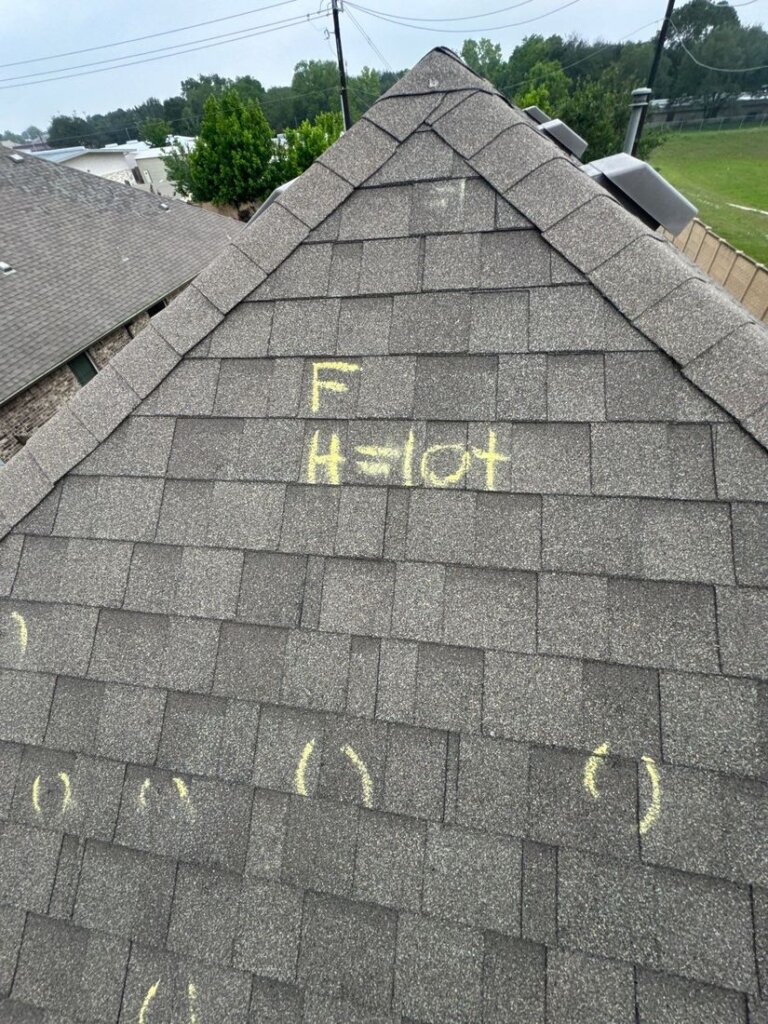
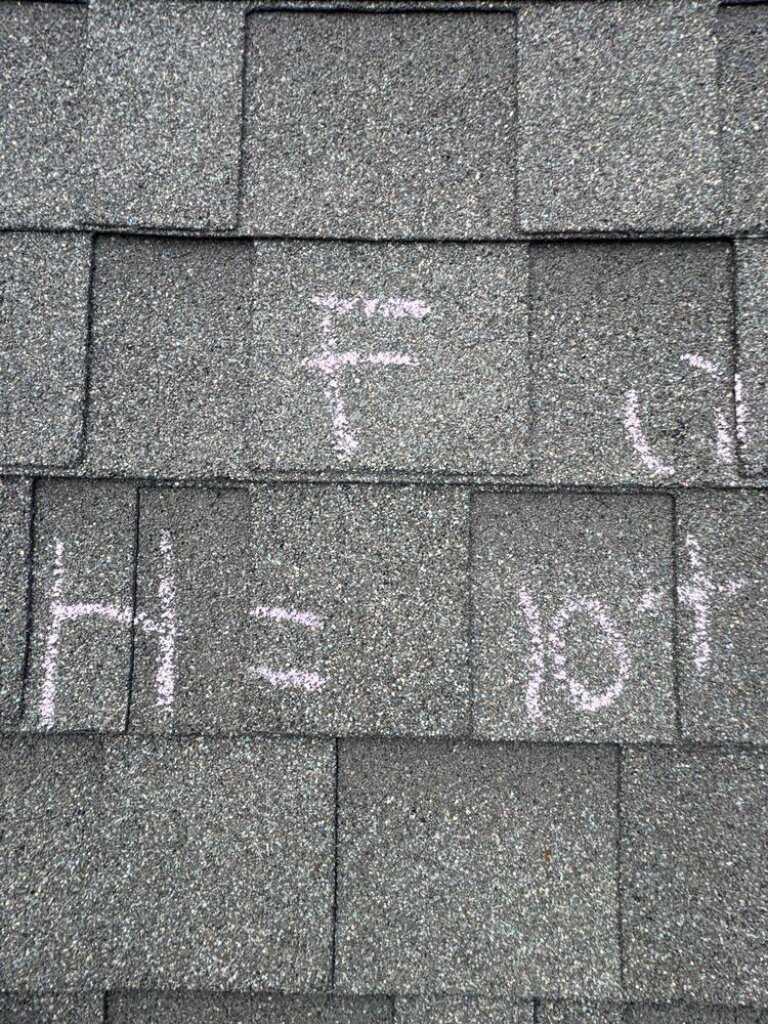
On the roof, an inspector works slope by slope. A common method is the test square: chalk a box on each slope that faced the storm, circle every hit inside it, and write the count next to it. Photos of those squares, slope by slope, are what an adjuster expects to see.
Beyond the shingles, a good inspection covers:
- Ridge caps and hip shingles, which take direct hits and crack easily
- Pipe boots, vents and skylights for dents, splits and broken seals
- Valleys and flashing, where dents can open a path for water
- The attic, for stains, wet insulation or light coming through the decking
- Signs that aren’t hail, so the report doesn’t claim wear as storm damage
Our inspections are free and covered by photos of everything we find. You get the photos, our findings and your options. If a few shingles can be repaired, we’ll tell you that. If the hail did enough damage to justify a claim, we’ll say so and explain why.
What we found on Pearland hail roofs
Four of the projects on our site are hail roofs in Pearland, Texas, and they show the pattern above.
- On a single-story home, hail bruising was marked across the shingle field and test squares were chalked on the slopes. The claim led to a tear-off to bare deck, a re-nailed deck, TopShield synthetic underlayment and GAF Timberline HDZ shingles.
- On a two-story brick and stone home with solar, the hail damage was documented for the adjuster before any work started. The panels were detached, the roof replaced with GAF Timberline UHD, and every solar mount flashed into the new roof.
- On a large custom home, a test square was marked for the adjuster and hail impacts showed on aged shingles before the roof was replaced with GAF StormGuard leak barrier and Timberline HD shingles.
Not every inspection ends in a new roof. When the damage is limited, a roof repair is the honest answer.
Does insurance cover hail damage on a roof in Texas?
Texas homeowners policies that include wind and hail coverage pay for hail damage, but how much you get depends on your deductible and on whether the roof is covered at replacement cost or actual cash value. The Texas Department of Insurance (TDI) advises filing quickly, photographing damage inside and out, covering holes to keep rain out, and keeping receipts for temporary repairs.
Many Texas policies use a percentage deductible for wind and hail, based on the dwelling limit rather than the size of the damage.
Worked example
- Dwelling limit: $300,000. Wind and hail deductible: 2%.
- Your deductible: $6,000, no matter what the roof costs.
- If the hail damage comes to $4,500, the insurer pays nothing. It may still be worth paying for a repair yourself.
- If a full replacement comes to $18,000, the claim is worth filing. The insurer’s share is figured after your $6,000.
Texas law bars a roofer from waiving, absorbing or rebating your deductible, and a roofer can’t act as your public adjuster or negotiate the claim for you, as TDI explains. A roofer can document the damage and meet the adjuster on the roof, which we do. For every step after the inspection, read our guide to the roof insurance claim process in Texas.
General information, not legal or insurance advice. Check your own policy for your deductible and coverage.
When hail damage isn’t worth a claim
Being honest about this saves you a claim on your record for nothing.
- The damage is under your deductible. A handful of hits on one slope often costs less to repair than a 1% or 2% deductible.
- The marks are cosmetic. Small dents on metal vents or gutters that don’t leak may not count as damage under your policy.
- The roof was already worn out. Adjusters separate storm damage from age. On an old roof with actual cash value coverage, the payout can be small. Our roof replacement cost guide helps you plan if you’re paying yourself.
Frequently asked questions
Can you see hail damage on a roof from the ground?
Sometimes. Broken or missing shingles show from the yard, but most hail hits on asphalt shingles are too small to see from below. Dented gutters, vents and AC fins, plus granules at the downspouts, are better clues. If you see those, have someone check the roof up close.
Does small hail damage a roof?
Hail under 1 inch rarely tears or cracks shingles, but it can knock off granules. The 2025 IBHS study found weathered shingles hit by small hail were about ten times more likely to be damaged by later severe hail. A roof that’s been through several small storms deserves a check.
Does hail damage cause roof leaks?
Not always right away. A hit that cracks the mat or breaks a pipe boot can leak in the next rain. A bruise that only strips granules lets the sun break down the asphalt faster, and the leak can show up months later. That’s why documenting damage soon after the storm matters.
How long do you have to file a hail claim in Texas?
Your policy sets the deadline, so check it. TDI tells homeowners to file quickly. Coastal homes insured through the Texas Windstorm Insurance Association have one year from the date of damage under Insurance Code chapter 2210.
What does a hail hit look like on a shingle?
A dark, round spot where granules are missing and the asphalt shows. Fresh hits have crisp edges and loose granules nearby. Press gently and the spot may feel soft. On older, brittle shingles, a hit can leave a crack or a broken corner instead.
Think hail hit your roof?
We’ll inspect the roof and attic for free, chalk and photograph every hit we find, and tell you straight whether it’s worth a claim. If it is, we’ll meet your adjuster on the roof. We’re open Monday through Friday, 8 AM to 6 PM, across our Texas service area.
Sources
- National Weather Service: Severe thunderstorm reference table (hail)
- National Weather Service: Hail size chart
- IBHS, Frontiers in Materials (2025): Sub-severe hail and asphalt shingle risk
- Insurance Information Institute: Facts and statistics, hail (NOAA Storm Prediction Center data)
- Texas Department of Insurance: Hail damage tips to file an insurance claim
- Texas Department of Insurance: Roofing and insurance, know the law
- Texas Legislature: Insurance Code chapter 2210, Texas Windstorm Insurance Association


