 Skip to content


If your roof starts leaking after a storm, make the room safe first, catch and contain the water, then photograph everything before you clean up. Next, cover the opening if it’s safe to do so, report the damage to your insurer quickly, and get wet materials drying within 24 to 48 hours so mold doesn’t start.
This guide walks through the first day hour by hour. It covers what Texas insurance rules expect from you and what a real ceiling repair involves.
Quick answer
- Safety first: stay away from wet electrical equipment and keep people out from under a sagging ceiling.
- Take photos and video before you move or throw anything away. Texas insurers and TDI both expect it.
- Make temporary repairs to stop more damage, and keep every receipt. Your policy may pay for them.
- Dry wet areas within 24 to 48 hours. That’s the EPA’s window for preventing mold.
The first hour: make it safe
Water and electricity are the real danger in a leak, not the stain on the ceiling. Ready.gov’s after-flood safety guidance applies inside a leaking house too: don’t touch electrical equipment if it’s wet or if you’re standing in water, and turn off the electricity only if it’s safe to do so. If water is dripping through a light fixture or ceiling fan, turn that circuit off at the breaker panel, as long as the panel itself is dry and you aren’t standing in water.
Next, look at the ceiling. A brown ring is a warning; a ceiling that bulges or sags is holding water, and drywall can give way under the weight. Keep people and pets out of that room and move furniture and electronics out from under it.
Stay off the roof while it’s wet, dark or still storming. A leak is expensive; a fall is worse. Everything in the next sections can be done from inside the house or from the ground.
Hours 1 to 3: contain the water and document it
- Put buckets or bins under each drip, with a towel inside to stop splashing. Lay towels or a tarp on the floor around them.
- Move rugs, boxes and furniture out of the wet area. Lift what you can’t move onto blocks.
- Take photos and video of the ceiling, the drip, the wet floor and anything damaged. TDI’s storm recovery tips say to take pictures and video of the damage.
- Go outside when the weather allows and photograph the roof from the ground: missing shingles, debris, a dented vent or gutter, a fallen limb.
- Write down the storm date and time. You’ll need it for the claim.
- Don’t throw anything away yet. TDI says not to throw anything away until your insurance adjuster tells you.
Hours 3 to 12: stop more water from getting in
TDI tells storm-hit homeowners to make temporary repairs to prevent more damage: remove standing water and cover holes to keep rain out. Keep a list of repairs and save the receipts. TDI’s hail column adds that your policy may pay for temporary repairs.
For a roof, a temporary repair usually means a tarp fastened over the damaged area, or sealing a lifted shingle or a torn pipe boot until the permanent repair. That’s work for a roofer with fall protection, not a ladder in the rain. Our storm damage team handles emergency leak response and gives same-day estimates for storm damage, with photos of what we find so you have them for your claim.
Before you call anyone
- Have your policy number and the storm date ready.
- Have your photos on hand, inside and outside.
- Know where the water shows up inside (room, ceiling, wall) so the inspector can trace it from above.
- Ask for written findings and photos, not just a verbal opinion.
Hours 12 to 24: report the claim and start drying
Report it quickly
TDI’s advice is to call your insurance agent or company as soon as possible to report property damage. Once you do, Texas law sets clocks for the insurer. According to TDI’s guide to claim deadlines:
| Step | Deadline | Notes |
|---|---|---|
| Insurer confirms it got your claim | 15 business days | The adjuster may inspect or review your photos |
| Insurer accepts or denies | 15 business days after it has everything it needs from you | Can be extended 45 days if the company explains why; a denial must be in writing with the reason |
| TWIA claims (coastal wind policies) | File within one year of the damage | Set by Texas Insurance Code chapter 2210 |
For the full claim, step by step, see our guide to the roof insurance claim process in Texas. If hail came with the storm, our photo guide to roof hail damage in Texas shows what the inspector looks for.
General information, not legal advice. Check your own policy for its notice and coverage terms.
Get things drying
The EPA’s guide to mold and moisture says to dry water-damaged areas and items within 24 to 48 hours to prevent mold growth. In most cases, mold won’t grow if wet materials dry in that window. Open interior doors, run fans and a dehumidifier, and keep the AC running if it’s safe to.
Absorbent materials are the problem. The EPA notes that porous materials such as ceiling tiles and carpet may have to be thrown away if they get moldy, and that mold can hide on the back side of drywall. Wet insulation above a ceiling holds water against the drywall and framing long after the surface looks dry. If mold covers more than about 10 square feet, the EPA points to professional cleanup guidance.
What a water-damaged ceiling repair really involves
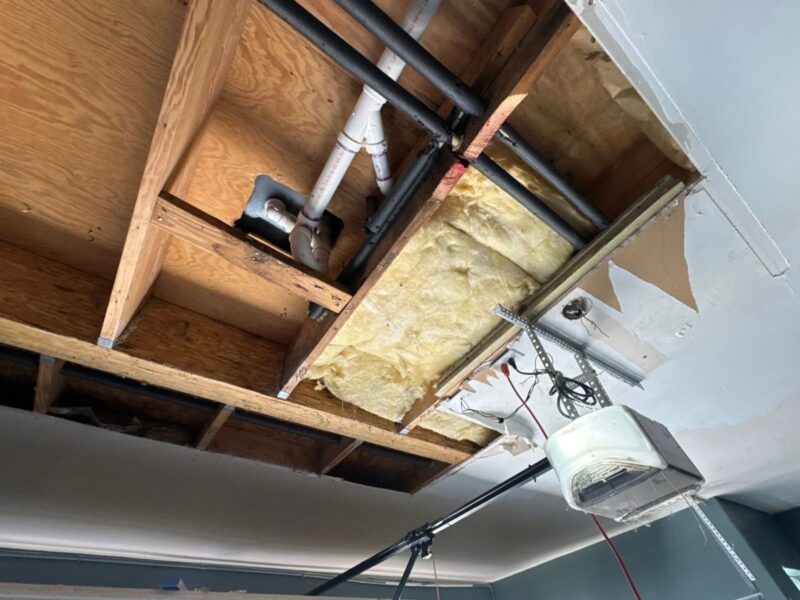
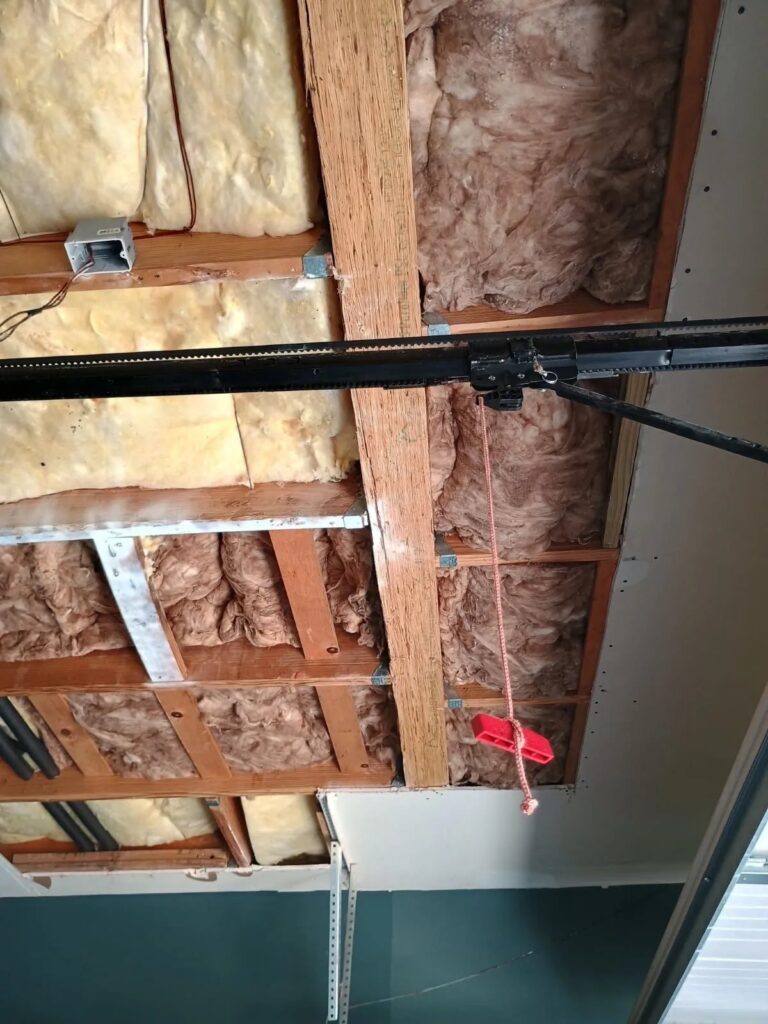
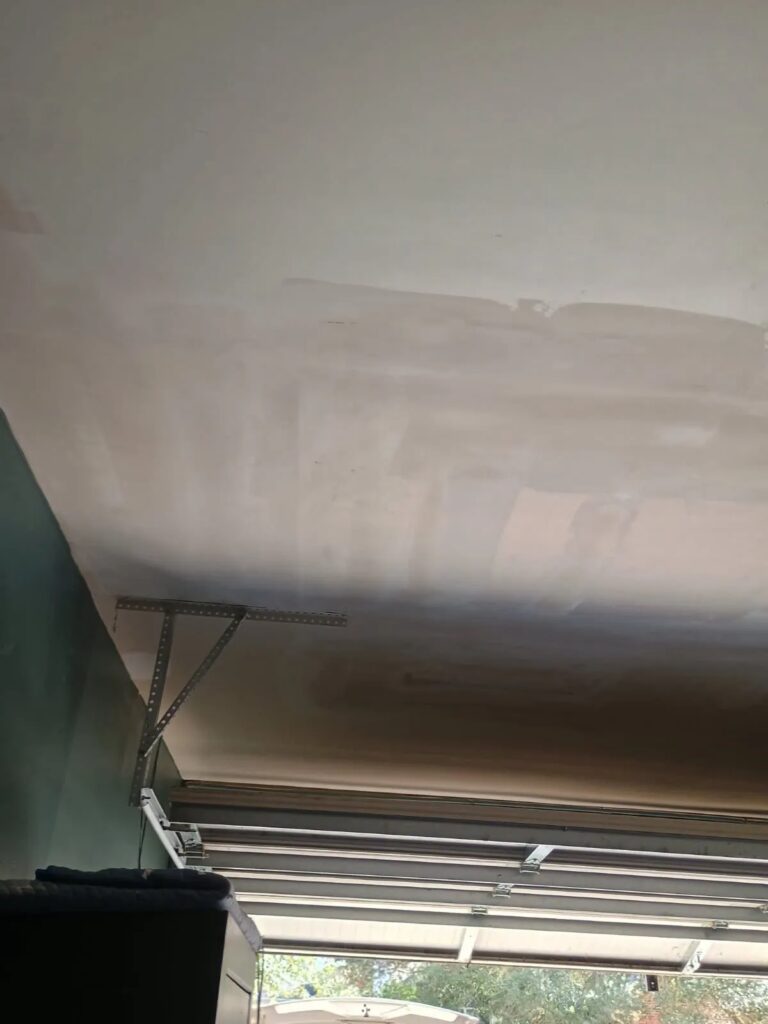
A stain painted over isn’t a repair if the insulation and framing above it stayed wet. On a garage ceiling restoration in Cypress, water damage had brought down part of the ceiling. The repair went in this order:
- Demolition back to sound material, so nothing wet or weakened stayed in place.
- Removal of the soaked insulation.
- Framing repair and structural bracing where the wood had been compromised.
- New drywall, then tape, float and finish to match the rest of the ceiling.
Interior repairs like this are part of our home restoration work for water, storm and disaster damage. The roof gets fixed first; otherwise the next rain ruins the new ceiling.
Does a storm leak mean you need a new roof?
Often not. A storm leak can come from a single spot: a few blown-off shingles, a lifted flashing, a cracked pipe boot. We recommend a repair when a repair is enough and replacement only when the roof needs it, and we’ll show you photos either way. A full replacement makes more sense when the damage is spread across the roof, as on the hail-damaged roofs we replaced in Pearland, or when the roof was already near the end of its life.
One caution: TDI notes that state law makes it illegal for contractors or roofers to offer to waive a deductible. If someone at your door offers to “cover” yours, that’s a red flag. We don’t waive, absorb or rebate deductibles; our financing page explains the legal ways to manage one.
Frequently asked questions
Will insurance cover a roof leak after a storm?
It depends on your policy and the cause. TDI says your insurer should pay for hail damage if you have wind and hail coverage. Insurers look at whether the storm caused the opening, so photos of the roof and the storm date matter. Check your own policy for exclusions and your deductible before you file.
My roof started leaking after a storm. Should I call a roofer or my insurance company first?
Do both the same day. Report the damage to your insurer as soon as possible, as TDI advises, and get a roofer out to stop more water from getting in. A roofer’s photos and written findings also help the adjuster see what happened. Keep receipts for any temporary repairs.
What should I do if my ceiling is leaking after a storm?
Turn off power to any wet fixture if it’s safe, keep people out from under a sagging ceiling, and catch the water in buckets. Photograph everything before cleanup. Then dry the area within 24 to 48 hours, as the EPA recommends, and have the ceiling opened up if insulation above it got soaked.
How long can a roof leak before mold grows?
The EPA says wet materials dried within 24 to 48 hours usually won’t grow mold. After that, risk climbs, especially in humid Texas weather and in hidden spots like wet insulation or the back of drywall. A small leak that drips for weeks can do more harm than a big one that’s fixed fast.
Can I put a tarp on my roof myself?
It’s safer to leave it to a roofer. Wet shingles are slick, wind catches a tarp like a sail, and nails or screws placed wrong can make a new leak. If you can’t get help right away, contain the water inside and photograph everything until a crew arrives.
Leak after a storm? We’ll come take a look
We’ll inspect your roof, attic and the leak for free, photograph what we find, and give you options: a repair, a replacement only if it’s needed, help with your insurance claim, and interior restoration. Send us a message through the contact form and we’ll reply within 2 hours.
Sources
- Texas Department of Insurance: Storm recovery tips
- Texas Department of Insurance: Hail damage tips to file an insurance claim
- Texas Department of Insurance: Insurance claim deadlines
- Texas Insurance Code chapter 2210 (TWIA)
- U.S. EPA: A brief guide to mold, moisture and your home
- Ready.gov: Floods (after-flood safety)


