 Skip to content


For most Texas homes, the best roofing material is a well-installed architectural asphalt shingle, and where hail hits often, an impact-resistant shingle rated Class 4 under UL 2218 is worth pricing. The right pick depends on what your part of Texas throws at a roof: hail, long hot summers, or coastal wind.
This guide compares the common materials against those three threats and explains what the impact ratings and insurance credits really mean. It also shows what we install on real Texas roofs.
Quick answer
- Architectural asphalt shingles are the best value for most Texas homes. They’re the material we install on our own projects (GAF, CertainTeed, Owens Corning and IKO).
- In hail country, ask for a shingle rated Class 4 under UL 2218, then check how it scored in independent IBHS hail testing. The label alone doesn’t tell you how it performs.
- Texas insurers set their own impact-resistant roof discounts. TWIA gives credits on the coast with TDI form PC068.
- The layers under the shingles (deck, underlayment, leak barrier) and the attic ventilation matter as much as the shingle.
What Texas weather does to a roof
Texas roofs take three kinds of punishment, and most parts of the state get more than one of them.
Hail
Texas recorded 902 hail events with stones 1 inch or larger in 2025, the most of any state and more than double second-place Kansas, according to the Insurance Information Institute’s summary of NOAA Storm Prediction Center data. The National Weather Service treats 1-inch hail as the start of severe hail.
Smaller hail matters too. A 2025 study by the Insurance Institute for Business and Home Safety (IBHS) found that hail under an inch knocked granules off shingles without denting or tearing them. Weathered shingles hit that way were about ten times more susceptible to granule loss from later severe hail. Over a roof’s life in Texas, those small storms add up.
Heat and sun
Long summers bake a roof from above and, in a poorly vented attic, from below. A 2026 paper from the National Institute of Standards and Technology (NIST) studied asphalt shingles exposed to UV light, heat and humidity in the lab. It notes that weathering may reduce a shingle’s ability to stand up to wind and impact. In plain terms, a shingle that held up well in year one won’t be as tough in year fifteen, especially under the Texas sun.
Wind, especially on the coast
Along the Gulf Coast, many homes are insured for wind through the Texas Windstorm Insurance Association (TWIA). TWIA says replacing a roof or repairing a large part of one needs a windstorm certificate of compliance issued by the Texas Department of Insurance (TDI). That means the work has to meet the windstorm building code for your area.
Which roofing material is best for Texas? A side-by-side look
This table compares the materials homeowners ask us about most. It’s general guidance; the right answer for your house depends on its age, roof pitch, budget and how often your area sees hail.
| Material | Hail | Heat and sun | Our take |
|---|---|---|---|
| 3-tab asphalt shingles | Thin, single layer; the most easily damaged option | Dark colors run hot; thin mat ages fastest | The thinnest option; compare it against architectural shingles on your quote |
| Architectural (laminated) asphalt shingles | Thicker, two-layer build; still bruises and loses granules in big hail | Lighter colors and good attic ventilation help | The best value for most Texas homes and what we install most |
| Impact-resistant asphalt shingles (UL 2218 Class 4) | Built to resist impacts; independent test scores vary by product | Same heat behavior as other asphalt shingles | Worth pricing in hail-prone areas, especially if your insurer gives a credit |
| Metal | Can dent in large hail even when it doesn’t leak | Reflective finishes can stay cooler | General information only; ask any metal installer for its impact and wind ratings in writing |
| Clay or concrete tile | Heavy tiles can crack under large hail | Handles heat well | General information only; needs a roof structure built for the weight |
We install asphalt shingle roofs. Metal and tile are listed here for comparison only.
Architectural asphalt shingles: the Texas workhorse
Architectural shingles are made of two bonded layers, so they’re thicker than old-style 3-tab shingles and lay flat with a dimensional look. They’re the standard choice on Texas homes because they balance price, looks and storm performance, and they’re straightforward to repair after a storm.
On our recent Pearland hail replacements we installed GAF Timberline HD, Timberline HDZ and Timberline UHD shingles, and we also install CertainTeed, Owens Corning and IKO products. Brand matters less than two things: the right product line for your exposure, and installation done to the manufacturer’s instructions, which keeps the manufacturer warranty valid.
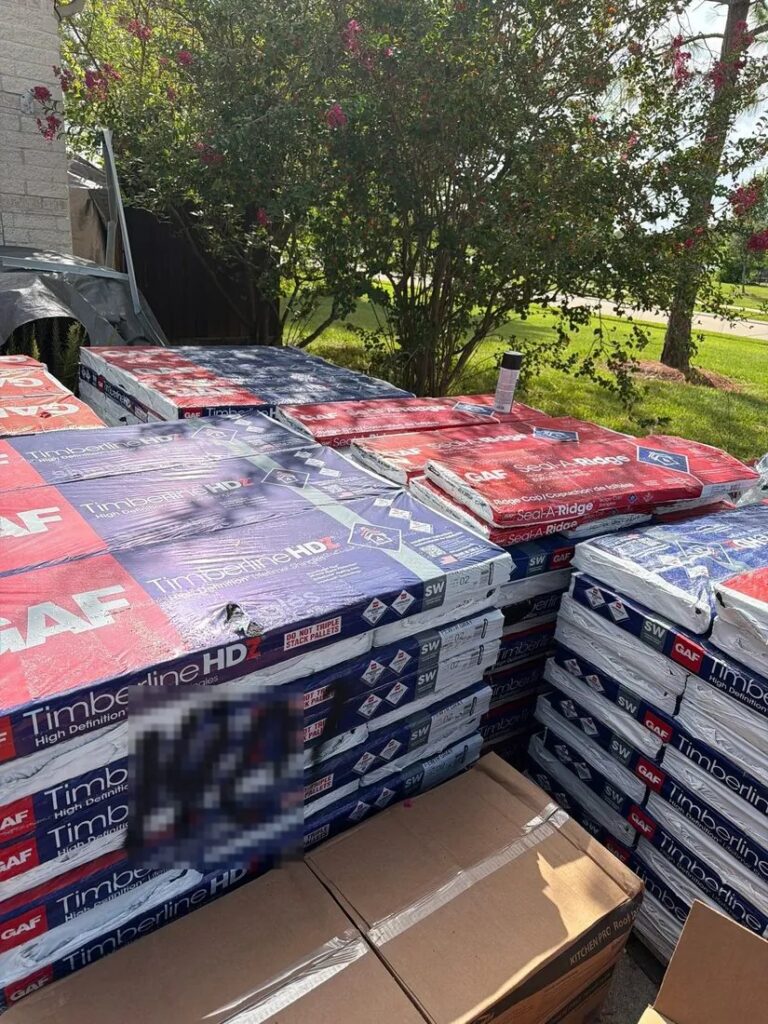
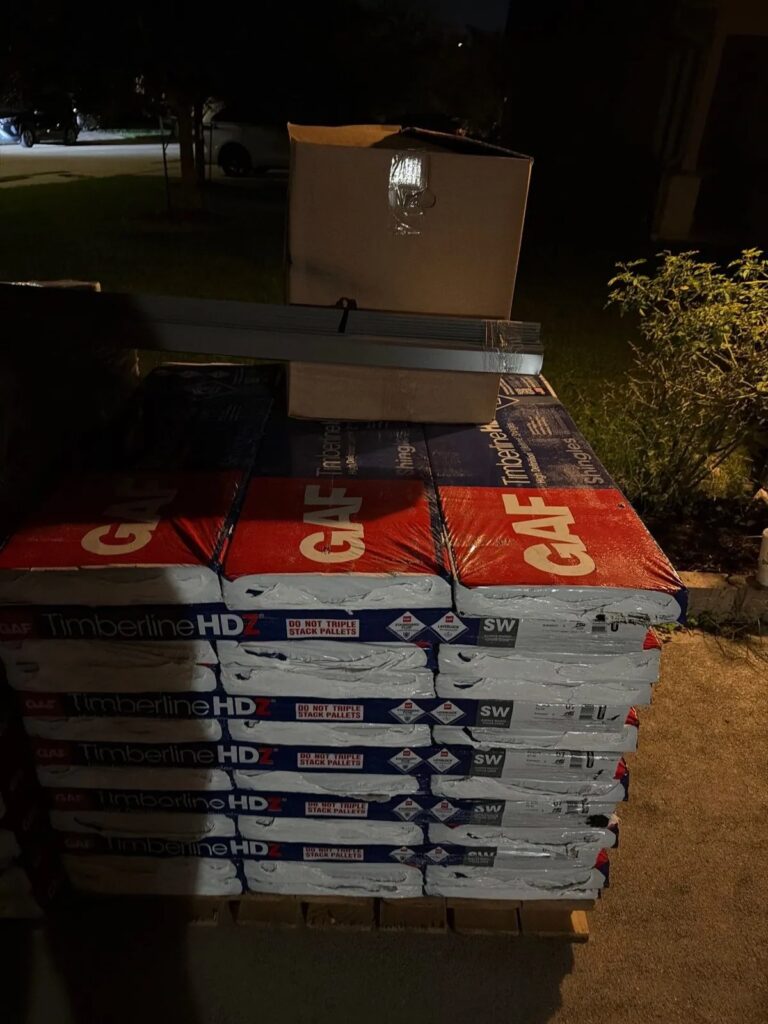
Before you sign, ask which exact product line the quote uses. “Architectural shingles” covers a range, and the bundle wrapper lists the product name and its ratings.
Are Class 4 impact-resistant shingles the best roof for Texas hail?
Impact-resistant shingles are tested under UL Standard 2218 and given a class from 1 to 4, with Class 4 the highest. TDI’s Impact-Resistant Roofing Installation Form (PC068) is how a roofer certifies which class was installed. The packaging has to show the UL 2218 class, the manufacturer, the date made and the brand name, and the homeowner gets a label from it.
Here’s the catch: a Class 4 label doesn’t mean every product performs the same. IBHS buys shingles from regular stores and fires lab-made hailstones at them. Its November 2025 ratings covered a record 24 impact-resistant products, and none earned Excellent; most rated Good. IBHS says products rated Marginal or Poor shouldn’t be used in hail-prone areas. You can look up a specific product in the IBHS impact ratings before you choose it.
What about the insurance discount?
TDI’s roofing discounts page says private insurers set impact-resistant roof discounts company by company, with their own testing, labeling and paperwork rules. TWIA does give credits for UL 2218 roofing, and a Class 4 roof gets its highest credit, but TWIA requires form PC068. So the only way to know your savings is to ask your own agent before you choose a shingle. Check your own policy, too, and ask whether the discount changes how cosmetic hail damage is covered.
Worked example: is the upgrade worth it?
- Get two quotes for the same roof: one with standard architectural shingles, one with a Class 4 product. Say the difference is $2,000. (Your number will differ.)
- Ask your agent for the yearly premium savings in dollars, not percent. Say it’s $250 a year.
- $2,000 ÷ $250 = 8 years to earn the upgrade back through the discount alone.
- If you plan to stay longer than that, or your area gets hail every few years, the upgrade starts to make sense. If your insurer gives no discount, it’s a judgment call on hail protection alone.
If the upgrade stretches the budget, our financing options through third-party lenders can cover upgrades alongside an insurance claim.
What’s the best roof for Texas heat?
For heat, color and ventilation do more than the material label. The Cool Roof Rating Council explains that a cool roof reflects sunlight and gives off the heat it does absorb, measured as solar reflectance and thermal emittance on a 0 to 1 scale. A cooler roof can cut air-conditioning use and may extend the roof’s service life. It doesn’t have to be white; some darker “cool color” products reflect well too. You can check a product’s rated values in the CRRC roof products directory.
Ventilation is the part people forget. Hot air trapped in an attic heats the shingles from underneath. On the Pearland two-story job with a solar array, we finished the new roof with a ridge vent. Our free inspection includes the attic, which is where ventilation problems show up.
The layers under the shingles matter just as much
Shingles shed most of the water, but the deck, underlayment and leak barrier are what stop a leak when wind lifts a tab or hail knocks a hole through. On a large custom home in Pearland, we repaired the deck, replaced a vent boot and ran GAF StormGuard leak barrier before the new shingles went on. On a single-story Pearland roof, we tore off to bare wood, re-nailed the deck and covered it with TopShield synthetic underlayment.
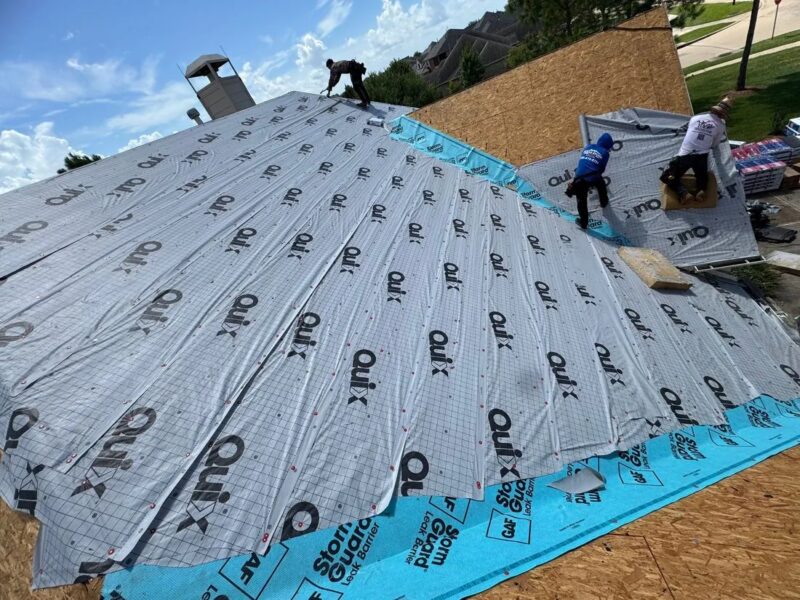
When you compare quotes, ask what goes under the shingles, not just the shingle name. Two quotes with the same shingle can be very different roofs.
What we’ve seen on Texas roofs
Our recent hail replacements in Pearland show why the full system matters:
- On a large custom home, the hail hits showed up on aged shingles. We tarped the beds and AC condensers, repaired the deck and installed GAF Timberline HD with StormGuard and Seal-A-Ridge cap.
- On a two-story brick and siding home, damaged decking was cut out and replaced before GAF Timberline HDZ went on.
- On a two-story home with solar, the panels were detached and reset and every mount was flashed into the new GAF Timberline UHD roof.
If you’re not sure whether your roof has hail damage now, our guide to spotting hail damage on a Texas roof shows real photos. For budgets, see roof replacement cost in Texas.
How to choose the right roof for your Texas home
- Look at your hail history. If your street has filed hail claims in the last few years, price a Class 4 product alongside a standard architectural shingle.
- Look up any impact-resistant product in the IBHS ratings. Skip anything rated Marginal or Poor.
- Call your insurance agent and ask for the impact-resistant discount in dollars, and whether it changes how cosmetic hail damage is covered.
- On the coast, confirm your roofer will build to the windstorm code and get the TDI certificate if you’re insured through TWIA.
- Choose a lighter or rated “cool” color if heat is your main problem, and ask how the attic will be vented.
- Compare what goes under the shingles: deck repairs, underlayment type and leak barrier at the eaves and valleys.
- Get the exact product names in writing, and the PC068 form if you’re installing an impact-resistant roof.
Frequently asked questions
What are the best roofing shingles for Texas?
For most homes, architectural asphalt shingles from a major manufacturer are the best mix of price and storm performance. In areas with frequent hail, a shingle rated Class 4 under UL 2218 that also scores well in IBHS hail testing is the stronger choice. Ask for the exact product line on your quote, not just “architectural shingles.”
What is the best roof for Texas heat?
Color and ventilation matter more than the material name. A roof that reflects sunlight and releases absorbed heat stays cooler, and the Cool Roof Rating Council publishes rated values for many products. Pair that with balanced attic intake and exhaust venting so heat doesn’t cook the shingles from below.
Are Class 4 shingles worth it in Texas?
Often, in hail-prone areas, but run the numbers. Ask for quotes with and without a Class 4 product, then ask your agent for the yearly discount in dollars. Divide the price difference by the yearly savings to see how long payback takes. Also check the product in the IBHS ratings, since Class 4 products don’t all perform the same. Our guide to whether Class 4 impact-resistant shingles are worth it in Texas walks through the cost, insurance and payback in more detail.
Do Texas insurers have to give a discount for impact-resistant shingles?
TDI says private insurers set these discounts company by company, with their own rules and paperwork. TWIA gives credits for roofing that passes UL 2218, with the highest credit for Class 4, and requires TDI form PC068. Ask your agent before you choose a shingle. This is general information, not legal advice.
What is the best roof for hail?
No common roof is hail-proof. Among asphalt shingles, impact-resistant products are built to take more, and IBHS ratings show how each one did against lab-made hailstones. Small hail still wears granules off any shingle over time, so a roof in hail country benefits from a check after big storms.
Not sure which roof fits your home?
We’ll inspect your roof and attic for free, document what we find with photos, and give you options in writing: repair, replacement with standard or impact-resistant shingles, insurance help and financing. No pressure to decide on the spot. Learn more about our residential roofing and storm damage services.
Sources
- Insurance Information Institute: Facts + Statistics: Hail (NOAA SPC data)
- National Weather Service: Severe hail reference
- IBHS, Frontiers in Materials (2025): Sub-severe hail and asphalt shingle risk
- NIST (2026): Long-term durability of asphalt shingle roof covers
- IBHS: 2025 impact-resistant shingle ratings release
- IBHS: Impact-resistant shingle performance ratings
- Texas Department of Insurance: Roofing discounts
- Texas Department of Insurance: Form PC068, Impact-Resistant Roofing Installation Form
- Texas Windstorm Insurance Association: Windstorm certification
- Cool Roof Rating Council: What is a cool roof?


